
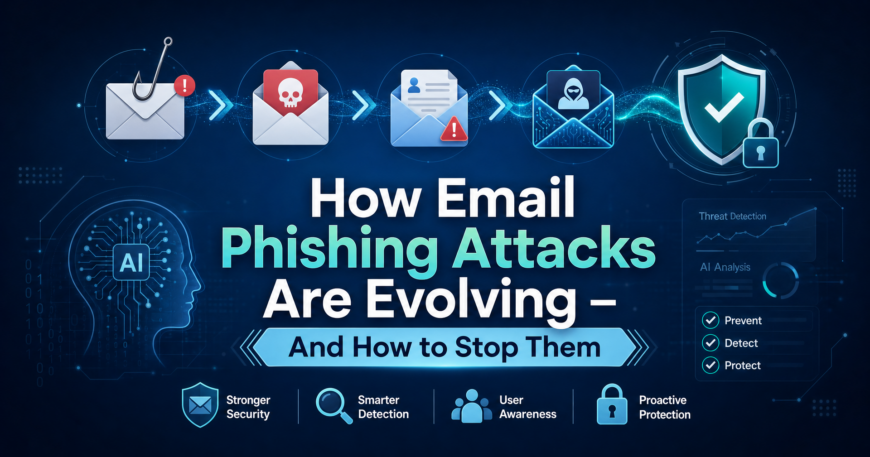
For years, phishing emails were relatively easy to spot. Poor grammar, suspicious links, and generic greetings made them stand out. Today, that’s no longer the case. Modern email phishing attacks are powered by artificial intelligence, automation, and stolen business data, making them more convincing than ever. Attackers can impersonate trusted vendors, executives, or even coworkers with near-perfect accuracy, turning a single click into a costly security incident.
According to Microsoft’s 2025 Digital Defense Report, the company now screens more than 5 billion emails every day for phishing and malware, highlighting the enormous scale of today’s email threats.
How Email Phishing Attacks Have Changed in 2026
Email phishing has evolved from mass spam campaigns into highly targeted attacks designed to bypass both technology and human judgment.
Instead of sending the same message to thousands of recipients, attackers now use AI to personalize emails, mimic writing styles, and create messages that blend naturally into everyday business conversations. They also combine phishing with credential theft, malware delivery, and business email compromise (BEC), increasing the likelihood of a successful attack.
Recent threat intelligence also shows a sharp rise in automated phishing campaigns and phishing-as-a-service platforms (1380% in 2026), allowing even less-skilled cybercriminals to launch sophisticated attacks at scale.
The New Tactics Businesses Need to Watch For
AI-Generated Emails
Generative AI has removed many of the traditional warning signs people relied on. Today’s email phishing attacks are grammatically correct, professionally written, and tailored to the recipient. Attackers can generate convincing messages in seconds, making large-scale phishing campaigns far more effective.
Business Email Compromise (BEC)
Rather than sending malicious attachments, many attackers now impersonate executives, vendors, or finance teams to trick employees into transferring money or revealing sensitive information. Because these emails often contain no malware, they can bypass traditional spam filters.
QR Code Phishing (Quishing)
Instead of suspicious links, attackers increasingly embed QR codes in emails. Scanning the code directs users to fake login pages that harvest Microsoft 365 or other business credentials, making these attacks harder for traditional email filters to detect.
MFA and Session Hijacking
Many email phishing campaigns no longer stop at stealing passwords. Modern attacks use adversary-in-the-middle techniques to capture authentication tokens or active sessions, allowing attackers to bypass traditional multi-factor authentication in certain scenarios.
Why Traditional Email Security Is No Longer Enough
Spam filters remain an important first line of defense, but they were never designed to stop every modern email phishing attack.
Today’s attackers exploit trusted cloud services, legitimate business platforms, and compromised accounts to make their emails appear authentic. Some attacks contain no malicious attachments or obvious indicators, relying entirely on social engineering to convince employees to take action.
As phishing techniques continue to evolve, organizations need security that extends beyond inbox filtering to include identity protection, endpoint security, real-time monitoring, and rapid incident response.
How to Protect Your Business Against Modern Email Phishing Attacks
Train Employees Continuously
Employees remain one of the most important layers of defense. Regular security awareness training, phishing simulations, and clear reporting procedures help staff recognize suspicious requests before damage occurs.
Strengthen Identity Security
Implement phishing-resistant multi-factor authentication wherever possible, enforce strong password policies, and apply conditional access controls to reduce the impact of stolen credentials.
Deploy Advanced Email Protection
Modern email security solutions analyze sender reputation, domain impersonation, attachments, URLs, and behavioral patterns rather than relying solely on keyword filtering. AI-powered detection can identify emerging threats before they reach employees’ inboxes.
Monitor for Suspicious Activity
Continuous monitoring helps detect unusual login behavior, impossible travel events, unauthorized mailbox rules, and other indicators of account compromise before attackers gain deeper access to business systems.
Develop an Incident Response Plan
No organization can guarantee that every phishing attempt will be blocked. Having a documented response plan ensures compromised accounts can be isolated quickly, affected systems investigated, and business operations restored with minimal disruption.
Why a Layered Security Strategy Works Best
There is no single tool that can eliminate email phishing attacks.
The most effective defense combines employee awareness, advanced email security, endpoint protection, identity management, regular software updates, and proactive monitoring. Each layer reduces the likelihood that a single mistake will become a serious security incident.
This approach is becoming increasingly important as cybercriminals continue using AI to improve both the quality and scale of phishing campaigns. Microsoft reports that attackers are using automation and AI to create more convincing attacks, while defenders must respond with equally intelligent security practices.
Read more: Email Security in 2026: Stopping Phishing Before It Reaches Your Inbox
How Managed IT Services Help Reduce Phishing Risk
Protecting a business from email phishing attacks requires ongoing attention, not just installing security software once and hoping for the best.
Managed IT providers continuously monitor email systems, apply security updates, review identity controls, investigate suspicious activity, and help businesses respond quickly when threats emerge. They also provide strategic guidance to ensure cybersecurity evolves alongside changing attack methods.
At Sun IT Solutions, we help businesses strengthen their defenses with managed IT services, advanced email security, cybersecurity solutions, proactive monitoring, and employee security best practices. By taking a proactive approach, we help reduce phishing risks before they disrupt your operations.
Get in touch and let us help you build a cybersecurity strategy that keeps pace with today’s evolving threats.

