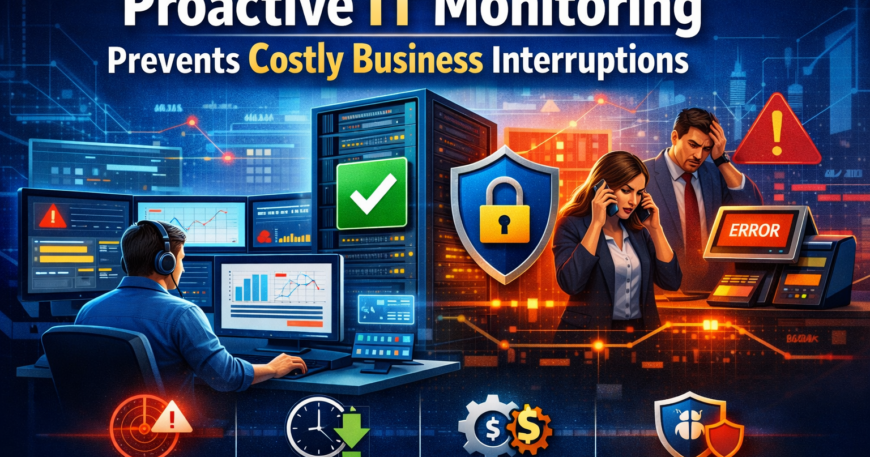
Most businesses only think about their IT when something breaks. The server goes down, emails stop working, or the point-of-sale system freezes mid-transaction — and suddenly everyone’s scrambling. The phone calls start, the productivity stops, and someone starts calculating how much this is going to cost. It’s a reactive cycle that plays out thousands of times a day across businesses of every size.
But here’s the thing: the vast majority of those moments are preventable. Not through luck, but through proactive IT monitoring — a systematic, always-on approach to watching your technology infrastructure before small issues snowball into expensive disasters.
Let’s break down what that actually means, why it matters, and what businesses stand to gain from making the shift.
The Real Cost of Downtime
Before we talk about solutions, let’s put the problem in perspective. IT downtime isn’t just an inconvenience; it’s a financial drain that hits harder than most businesses realize.
The cost of IT downtime for large enterprises is up to $9,000 per minute. Even for SMBs, hourly losses routinely exceed $10,000. Moreover, 60% of small businesses that suffer a significant cyberattack go out of business within six months — many due to issues that proactive monitoring could have flagged early.
Think about what goes wrong during even a short outage:
- Employees can’t access files.
- Customer-facing systems go dark.
- Orders don’t process.
- Support queues pile up.
And when you finally get everything back online, there’s still the time lost recovering data, communicating with frustrated customers, and patching whatever broke in the first place.
Now multiply that across a year of unplanned incidents, and the numbers become genuinely alarming. The question isn’t whether downtime costs your business money. It’s whether you are doing anything to prevent it. That’s where proactive IT monitoring comes into play.
What Proactive IT Monitoring Actually Means
Proactive IT monitoring is exactly what it sounds like: instead of waiting for something to fail, you’re continuously observing your systems — servers, networks, endpoints, cloud infrastructure — so that when something starts to drift toward failure, you catch it first.
This is fundamentally different from reactive IT support, where a technician gets called in after the damage is already done. Proactive monitoring means alerts go off:
- When CPU usage spikes abnormally
- When a hard drive starts showing signs of failure
- When network traffic patterns suggest a security threat
- When a critical software update has been missed.
Problems get addressed at 2 a.m. before your team even walks in the door.
This kind of monitoring is made possible by RMM tools — Remote Monitoring and Management platforms that give IT teams (or your managed service provider) a real-time, centralized view of your entire IT environment. RMM tools automate routine checks, generate alerts for anomalies, push patches and updates remotely, and create audit trails that help teams diagnose recurring issues. They are, in many ways, the backbone of any serious proactive IT strategy.
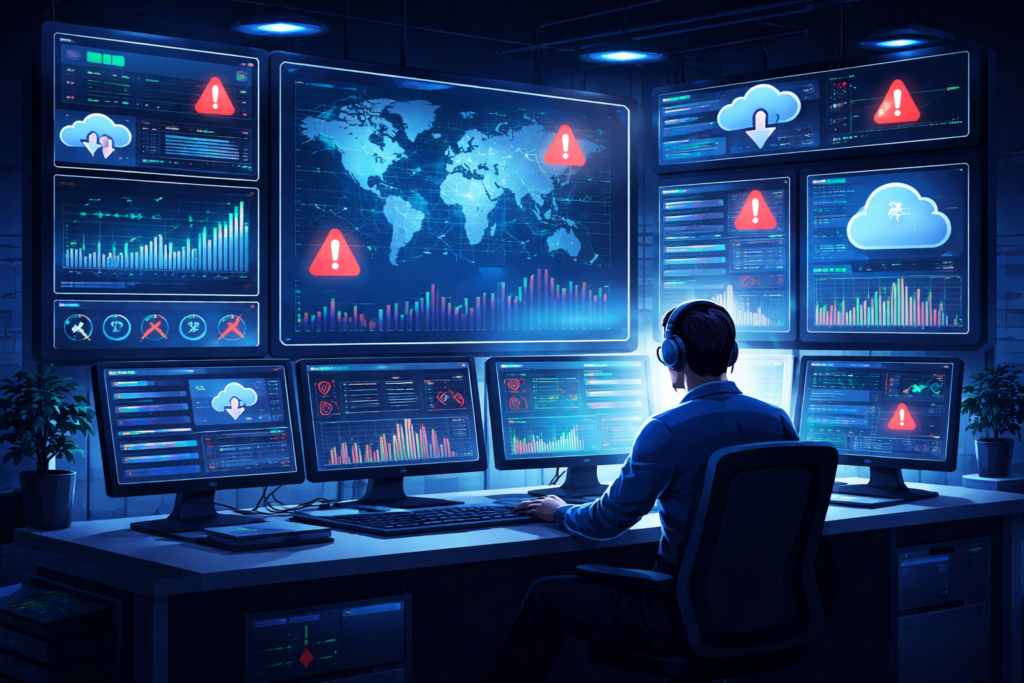
The comprehensive proactive IT monitoring strategy typically covers:
- Network performance and availability: Latency spikes, packet loss, and bandwidth saturation that degrade user experience before causing outright failure.
- Endpoint health: Laptops, desktops, and mobile devices checked for OS vulnerabilities, disk health, and performance metrics.
- Security threats: Unusual login attempts, unauthorized access, malware signatures, and configuration changes that deviate from baseline.
- Backup integrity: Verifying that backups are actually complete — and are actually restorable. This alone saves businesses from catastrophic data loss.
- Cloud infrastructure: Usage and cost anomalies, misconfigurations, and availability of cloud-hosted services and applications.
Overall, proactive IT monitoring transforms IT management from a reactive firefighting approach into a preventive strategy that keeps systems stable, secure, and continuously available.
The Shift from Break-Fix to Prevention
The traditional IT model, often called “break-fix”, works like this: something breaks, you call someone, they fix it, you pay them, and life goes on until the next thing breaks. For small businesses without a dedicated IT department, this model can feel like the only option. But it’s expensive, unpredictable, and risky as businesses grow more dependent on digital infrastructure.
Proactive monitoring flips this entirely. It treats your IT infrastructure the way you’d treat a fleet of company vehicles — with regular maintenance, scheduled check-ins, and early warnings before a breakdown strands someone on the highway. Businesses that adopt this model typically see fewer incidents, faster resolution times, and significantly lower overall IT costs compared to break-fix counterparts.
This is why so many businesses are turning to managed IT providers who offer proactive services as a core part of their model. Companies seeking managed IT in Toronto, for example, are increasingly choosing partners who lead with prevention, not just repair, because the math simply makes more sense.
6 Reasons How Proactive IT Monitoring Prevents Interruptions
1. Early Detection Prevents Major Failures
One of the biggest advantages of proactive monitoring is the ability to identify problems before they impact users.
Modern monitoring systems analyze system logs, performance data, and hardware indicators to detect unusual patterns. These insights allow IT teams to intervene early. For example:
- A hard drive showing signs of failure can be replaced before it crashes
- A network bottleneck can be resolved before it slows operations
- A security vulnerability can be patched before attackers exploit it
Predictive monitoring tools can even detect system anomalies 24–48 hours before they cause operational issues, giving organizations valuable time to respond.
Businesses that implement proactive IT monitoring often rely on centralized RMM tools to automate these early warning systems and streamline response times.
2. Significant Reduction in Downtime
Proactive monitoring dramatically reduces the likelihood and duration of outages.
Organizations that implement proactive monitoring often experience 85–95% reductions in unplanned downtime within the first year.
In addition, monitoring tools can prevent up to 80% of potential IT outages by detecting problems early and initiating corrective actions.
Even when incidents do occur, proactive monitoring helps IT teams diagnose the root cause quickly, reducing the time required to resolve the issue.
For companies working with managed IT Toronto providers, this process is often supported by dedicated 24/7 IT support, ensuring that system alerts are addressed immediately, even outside regular business hours. So, instead of a four-hour outage, problems may be resolved in minutes.
3. Lower IT Costs and Emergency Repairs
Reactive IT management often leads to expensive emergency repairs, overtime labor, and unplanned system replacements.
Proactive monitoring significantly reduces these costs by enabling preventive maintenance. For example:
- Replacing failing hardware early is cheaper than recovering from a server crash
- Updating outdated software prevents costly vulnerabilities
- Routine maintenance extends the lifespan of the IT infrastructure
Preventive actions not only reduce repair costs but also extend the useful life of hardware and software assets.
Many organizations using managed IT Toronto services benefit from cost-effective infrastructure monitoring powered by RMM tools, which automate routine maintenance and patch management tasks. As a result, businesses benefit from more predictable IT spending and fewer financial surprises.
4. Improved Productivity Across the Organization
Technology issues don’t just affect IT teams; they disrupt entire organizations.
When systems slow down or fail, employees waste time waiting for tools to work or contacting support teams. Over time, these small interruptions can significantly impact productivity.
Proactive monitoring helps maintain stable system performance by continuously tracking key performance indicators like:
- Server response times
- Network speed
- Application availability
With 24/7 IT support, issues can be addressed immediately, even during nights, weekends, or holidays.

By resolving issues before they affect users, businesses ensure employees can focus on their tasks instead of troubleshooting technology. Moreover, reliable systems lead to smoother workflows, faster collaboration, and improved operational efficiency.
5. Stronger Cybersecurity and Risk Prevention
Cybersecurity threats are another major cause of business interruptions. Data breaches, ransomware attacks, and system vulnerabilities can bring operations to a standstill.
Proactive monitoring helps strengthen security by continuously scanning systems for suspicious behavior, unauthorized access attempts, or unusual network activity.
Modern RMM tools play an important role here by enabling automated patch management, vulnerability scanning, and threat detection.
Combined with 24/7 IT support, these tools ensure that potential threats are investigated and contained quickly. This continuous vigilance reduces the likelihood that cyberattacks will escalate into major disruptions.
6. Faster Incident Response and Resolution
Even the best IT environments occasionally experience issues. The difference is how quickly those issues are resolved.
Proactive monitoring tools provide IT teams with real-time alerts and diagnostic data, allowing them to identify the root cause immediately.
Organizations that invest in proactive IT monitoring often rely on remote troubleshooting features built into RMM tools to fix issues without physically accessing systems. This reduces the mean time to resolution (MTTR) and ensures systems return to normal quickly.
Instead of investigating problems manually, IT teams can act immediately with automated responses and data-driven insights.
Making the Shift: Where to Start
If your business is currently operating in a reactive mode, the transition to proactive monitoring doesn’t have to be overwhelming. Start by auditing what you have: What systems are business-critical? Where have outages or slowdowns hit you hardest in the past year? What’s currently unmonitored?
From there, the right managed services partner, like Sun IT Solutions, can design a monitoring framework around your actual risk profile. It’s not one-size-fits-all. A law firm with strict data compliance requirements has different needs than a manufacturing company with IoT-connected equipment. But the foundation is the same: continuous visibility, early intervention, and a team that treats your uptime as seriously as you do.
Conclusion
Technology failure is not a matter of if — it’s when. The only real variable is whether you’re in a position to catch problems before they catch you. Proactive IT monitoring, powered by modern RMM tools and backed by around-the-clock support, is how smart businesses take control of that variable.
The businesses that struggle most with IT are rarely the ones with the most complex systems. They’re the ones still waiting for something to break before they act. Don’t be one of them.
If you want to leverage the benefits of proactive monitoring without managing everything internally, partner with Sun IT Solutions. Our team delivers proactive IT support, 24/7 monitoring, cybersecurity protection, and cloud services to keep systems secure and running smoothly. With fast response times and a high first-call resolution rate, we help prevent IT issues before they disrupt your business.
Contact us today and let us help you build a smarter, more resilient IT environment

