

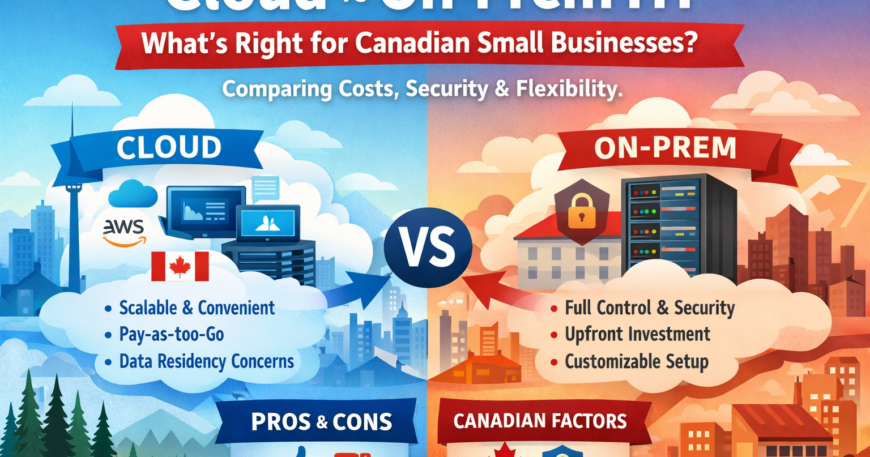
You wouldn’t build a new office without thinking about whether to buy or lease. The same logic applies to your IT infrastructure. For Canadian small businesses, the stakes have never been higher. Whether you’re running a professional services firm in Toronto’s financial district, a manufacturing shop in Hamilton, or a healthcare practice in Vancouver, the choice between cloud vs on-prem IT will shape your costs, security, flexibility, and competitive edge for years to come.
The good news? There’s no universally right answer — only the right answer for your business. But to make that call confidently, you need to understand the real trade-offs, the Canadian-specific factors most guides overlook, and where each model genuinely excels.
Let’s Define the Playing Field
On-Premises IT: You Own It, You Run It
On-premises (or “on-prem”) infrastructure means your servers, storage, networking equipment, and software licences live inside your physical location or in a colocation data centre you contract directly. You buy the hardware, your team (or your IT provider) manages it, and your data never leaves your building unless you explicitly send it somewhere.
It’s the traditional model. It’s also increasingly seen as the more complex and capital-intensive one, but for specific industries and use cases, it remains the gold standard.

Cloud Services: Pay for What You Use
Cloud computing means your IT infrastructure Toronto is hosted on third-party servers, think Microsoft Azure, Amazon Web Services (AWS), or Google Cloud, and delivered to you over the internet. You pay a monthly subscription rather than a large upfront capital investment. Providers handle patching, redundancy, and physical security. Your team just uses the services.
For most Canadian SMBs, this manifests as Microsoft 365 for productivity, cloud-hosted accounting software like QuickBooks Online, or full infrastructure-as-a-service (IaaS) environments for apps and data.

The Canadian Context: Why the On-Prem vs Cloud Decision Is Different Here
If you are reading a US-focused IT guide and applying it directly to your Canadian business, you’re missing critical nuances. Several factors make the cloud vs on-prem decision distinctly Canadian:
1. PIPEDA and Provincial Privacy Laws
Canada’s Personal Information Protection and Electronic Documents Act (PIPEDA) — and its stricter provincial equivalents in Quebec (Law 25), British Columbia, and Alberta — impose real obligations on how personal data is stored and processed. Law 25 in Quebec, fully in effect since September 2023, introduces some of the strictest data privacy requirements in North America, including mandatory privacy impact assessments and explicit consent requirements for cross-border data transfers.
This doesn’t mean cloud is off the table, but it does mean you need to ask hard questions about where your cloud provider stores your data and under what legal jurisdiction it falls.
2. Data Residency and Cross-Border Concerns
The USA PATRIOT Act and its successors mean that US-based cloud providers — even when storing data on Canadian soil — may be compelled to share data with US authorities without notifying Canadian customers. For businesses handling sensitive client data, this is a genuine risk that on-premises infrastructure or cloud services Canada providers can mitigate.
3. Internet Infrastructure Outside Major Centres
Cloud computing is only as good as your internet connection. In Toronto, Montreal, or Calgary, bandwidth is rarely a barrier. But for businesses in smaller centres or rural areas, connectivity constraints can make cloud-dependent operations genuinely unreliable.
The Real Cost Comparison
Cost is almost always the first question in cloud vs on-prem comparison, and it’s also the most frequently misunderstood one. The comparison isn’t as simple as monthly subscription vs upfront hardware spend.
On-Premises: True Cost of Ownership
On-prem costs are front-loaded but ongoing. For a small business deploying a proper server infrastructure, expect:
- Server hardware: $5,000–$25,000+ depending on scale and redundancy
- Networking equipment (switches, firewall, UPS): $2,000–$8,000
- Software licences (OS, security, backup): $1,500–$5,000 annually
- Maintenance contracts and IT support: $3,000–$15,000+ annually
- Power, cooling, and physical space costsRefresh cycle: full hardware replacement every 3–5 years
A realistic five-year total cost of ownership (TCO) for on-prem IT infrastructure in Toronto for a 20-person business often lands between $60,000 and $120,000 — and that’s before accounting for unexpected failures or urgent upgrades.

Cloud: The Predictable Monthly Model
Cloud costs are ongoing and variable but highly predictable. Microsoft 365 Business Standard runs approximately $17 CAD per user per month, meaning a 20-person business pays roughly $4,080 CAD annually for productivity, email, Teams, and cloud storage.
For more comprehensive IaaS environments, costs scale with usage. But critically, there are no capital expenditures, no refresh cycles, and no emergency hardware bills at 2 a.m.
Side-by-Side: Cloud vs. On-Premises
Here’s how the two models stack up across the factors that matter most to Canadian SMBs:
| Factor | Cloud | On-Premises |
| Upfront Cost | Low — subscription-based | High — hardware & licensing |
| Ongoing Cost | Predictable monthly fees | Maintenance, upgrades, staff |
| Scalability | Near-instant, elastic | Slow — requires new hardware |
| Data Sovereignty | Requires Canadian data residency clauses | Full local control |
| Disaster Recovery | Built-in redundancy & backups | Manual setup required |
| Remote Access | Seamless from anywhere | Requires VPN infrastructure |
| IT Staff Required | Minimal (vendor-managed) | Dedicated staff often needed |
| Compliance (PIPEDA) | Possible with right provider | Easier to control directly |
| Customization | Limited to vendor offerings | Deep, granular control |
| Typical Best Fit | SMBs, growth-phase businesses | Regulated industries, fixed needs |
Where Cloud Wins for Canadian SMBs
For the majority of small and medium-sized businesses in Canada, cloud services offer a compelling set of advantages:
Scalability Without Capital Risk
Growing from 10 to 40 employees? With the cloud, you add licences. With on-prem, you buy new servers, expand your network, and potentially hire more IT staff. The cloud scales in minutes; on-prem scales in months and dollars.
Built-In Disaster Recovery
Reputable cloud providers maintain 99.9% or higher uptime SLAs backed by geographic redundancy — your data is replicated across multiple data centres. For most SMBs, replicating this level of resilience on-premises would cost tens of thousands of dollars in redundant hardware, backup systems, and colocation fees.
Remote and Hybrid Work Readiness
Post-pandemic, the ability to work from anywhere is no longer optional for most businesses. Cloud-native infrastructure makes remote work seamless. On-prem solutions require VPN infrastructure, split-tunnelling configurations, and often create security headaches that cloud-native zero-trust architectures have already solved.
Lower IT Burden
Small businesses rarely have the in-house IT depth to properly manage on-premises infrastructure. Patching, monitoring, security updates, and incident response all require expertise and time. Cloud services Canada handles this overhead, letting your team focus on your actual business.
Where On-Premises Still Wins
Don’t write off on-prem entirely. There are meaningful scenarios where it remains the superior choice:
Highly Regulated Industries
Healthcare providers subject to provincial health information legislation, financial institutions with OSFI compliance requirements, and legal firms with strict solicitor-client privilege obligations often find that on-premises infrastructure gives them cleaner, more defensible control over data access and audit trails.
Latency-Sensitive Applications
Manufacturing operations using real-time process control systems, trading platforms, or any application where milliseconds matter often require local computing. Routing traffic through a cloud provider’s data centre introduces latency that on-premises infrastructure eliminates entirely.
Long-Term Cost Stability
If your business has stable, predictable workloads and the IT staff to manage them, on-prem can be cheaper over a 7–10 year horizon. Cloud subscription costs aren’t static — prices increase, usage grows, and egress fees (charges for moving data out of the cloud) can create cost surprises.
Air-Gapped Security Requirements
Some security-critical environments — government contractors, defence suppliers, certain research institutions — require infrastructure that is literally disconnected from the public internet. Cloud-based solutions are, by definition, incompatible with air-gapped requirements.
The Hybrid Approach: Best of Both Worlds?
Many Canadian businesses are finding that the binary cloud-vs-on-prem question is a false choice. A thoughtfully designed hybrid architecture can deliver cloud agility for everyday workloads while keeping sensitive data and latency-critical processes on-premises.
For example, a common pattern for Toronto-area professional services firms is:
- Microsoft 365 in the cloud for email, collaboration, and productivity
- Cloud-hosted CRM and project management tools
- On-premises or colocation-hosted database server for sensitive client records
- Local network-attached storage (NAS) for large media or design files
- Cloud-based backup as a secondary tier for on-premises data
This architecture delivers the flexibility and cost benefits of cloud where they matter most, while preserving control where compliance or performance requires it.

Questions Every Canadian SMB Should Ask Before Deciding
Before you sign a cloud contract or refresh your on-prem hardware, work through these decision-making questions:
- What types of data do we store, and what are our legal obligations under PIPEDA or provincial law?
- Do we have in-house IT staff capable of managing and securing on-premises infrastructure?
- What is our internet connectivity situation — is our bandwidth reliable enough for cloud dependency?
- Are our workloads stable and predictable, or do they fluctuate significantly?
- What is our realistic 5-year IT budget, and do we prefer capital or operational expenditure?
- Do any of our clients or contracts impose data residency or security requirements?
- What is our current disaster recovery posture, and what would a major outage cost us?
- Are we planning to grow significantly in the next 2–3 years?
Cloud Migration in Canada: What the Data Tells Us
Canadian businesses are moving to the cloud, but more deliberately than their US counterparts, often due to the privacy and sovereignty concerns outlined above.
Cloud providers invest billions annually in security infrastructure that no SMB could match independently. Microsoft alone employs over 8,500 security professionals and spends more than $4 billion USD per year on cybersecurity. For small businesses that are increasingly targeted by ransomware and phishing attacks, cloud platforms offer a meaningful security uplift, provided they’re configured correctly.
Making the Right Call for Your Business
After working through the data, here’s a straightforward framework for Canadian SMBs:
Choose Cloud If You…
- Have fewer than 50 employees and limited in-house IT expertise
- Need to support remote or hybrid work reliably
- Are growing and want infrastructure that scales with you
- Want predictable monthly costs without capital expenditure
- Don’t handle highly regulated data requiring physical control
Choose On-Premises If You…
- Operate in a heavily regulated industry with strict data control requirements
- Have stable, high-volume workloads and dedicated IT staff
- Have latency-sensitive applications requiring local compute
- Have already invested significantly in hardware with years of life remaining
- Operate in an area where internet reliability is a genuine concern
Consider Hybrid If You…
- Have a mix of sensitive and non-sensitive data with different compliance requirements
- Want cloud agility for collaboration tools while retaining control of core data
- Are transitioning away from on-premises over time, and want a gradual migration
The Bottom Line
There’s no shortcut here. The cloud vs on-prem decision is genuinely consequential, and the right answer depends on your industry, your team, your data obligations, and your growth ambitions. What is clear is that doing nothing is increasingly not an option. Ageing on-premises infrastructure without a refresh plan is both a security liability and a competitive disadvantage.
For most Canadian small businesses, a cloud-first or hybrid approach makes strong financial and operational sense today. But get the compliance piece right, especially if you’re in Quebec, British Columbia, or Alberta, and make sure your provider can answer clear questions about where your data lives and who can access it.
For small businesses that want expert guidance during on-prem vs cloud adoption, partnering with a trusted managed service provider can reduce risk and simplify the process. Sun IT Solutions supports organizations across Canada with managed IT services, cloud infrastructure deployment, and advanced cybersecurity protection. From proactive monitoring and help desk support to backup, disaster recovery, and network management, our team ensures your IT environment remains secure, reliable, and ready to scale.
Book your free consultation and let us help you set up the best IT infrastructure in Toronto.

