For most businesses, technology problems rarely stay confined to the IT department. When the network slows down, an employee cannot access Microsoft 365, or a critical application stops working, the impact spreads quickly across the organization. Employees lose time, customers may face delays, and managers have to shift their attention from business priorities to technical problems.
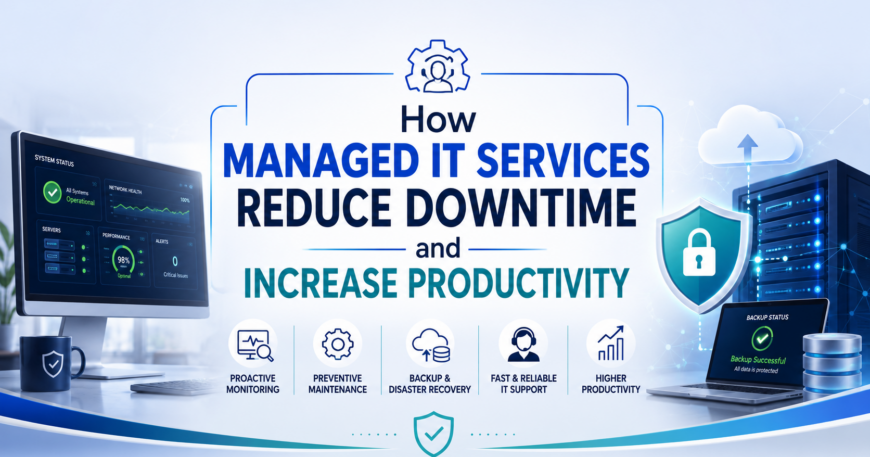
This is where managed IT services can make a real difference. Instead of waiting for systems to fail, a managed service provider (MSP) continuously monitors, maintains, secures, and supports the technology a business depends on. The result is fewer preventable disruptions, faster resolution when something does go wrong, and more time for employees to focus on productive work.
Why Downtime Costs More Than You Think
Downtime is often measured by how long a system is unavailable, but the real impact is broader. An employee who cannot access files may spend an hour waiting for a fix. A sales team without email or CRM access can miss opportunities. A manufacturing or logistics business may have to pause operations entirely if its systems go offline.
There are also less obvious costs, including emergency IT work, delayed projects, missed deadlines, customer frustration, and the time managers spend coordinating a recovery.

Cybersecurity incidents can make these disruptions even more serious. According to the Canadian Centre for Cyber Security, the total recovery costs associated with cybersecurity incidents reported by Canadian businesses doubled to CAD $1.2 billion.
For businesses that rely heavily on technology, preventing even a portion of these disruptions can have a meaningful effect on productivity and operating costs.
How Managed IT Services Reduce Downtime
Proactive Monitoring Catches Problems Earlier
One of the biggest advantages of managed IT services is that your systems are monitored rather than only checked when something breaks.
Monitoring tools can watch servers, workstations, networks, applications, storage, and other infrastructure for unusual activity or performance issues. If a device begins showing signs of failure or a system starts running out of capacity, the IT team can investigate before employees experience a major outage.
This changes the role of IT from emergency repair to prevention. Not every failure can be predicted, but many problems can be identified and addressed before they become business interruptions.
Preventive Maintenance Keeps Systems Healthy
Technology needs regular maintenance just like any other business infrastructure.
Managed IT services can include automated patching, software updates, device maintenance, security checks, and hardware lifecycle management. Keeping systems current can reduce compatibility problems, close known security vulnerabilities, and prevent issues caused by outdated software.
The Canadian Centre for Cyber Security recommends that small and medium organizations automatically patch operating systems and applications where possible because unpatched vulnerabilities can be exploited by threat actors.
Rather than relying on employees to remember updates or waiting until a problem appears, managed IT makes maintenance part of the normal operating process.
Backup and Disaster Recovery Limit the Impact of Major Failures
Some disruptions cannot be prevented. Hardware can fail, ransomware can spread, employees can accidentally delete important information, and unexpected events can take systems offline.
That is why backup and disaster recovery are essential parts of a downtime strategy. A good plan defines what needs to be backed up, how often backups occur, where recovery copies are stored, and how quickly critical systems need to be restored.

Regular testing matters, too. A backup that has never been tested may not provide much confidence when a real emergency occurs.
Read more: Understanding the Role of Managed IT Services in Business Continuity Planning
How Managed IT Services Increase Employee Productivity
Reducing downtime is only half the equation. Managed IT services can also improve productivity by removing the everyday technology frustrations that quietly consume employee time.
Faster Help When Employees Have Problems
Not every IT issue causes an outage. Password problems, application errors, printer issues, connectivity problems, and software questions can all interrupt someone’s work.
Without dedicated IT support, employees may try to troubleshoot problems themselves or wait for an internal employee who happens to know how to fix them. That creates an unnecessary productivity drain.
A managed IT help desk gives employees a clear place to go when technology gets in the way. Issues can be prioritized, tracked, and resolved without pulling other employees away from their primary responsibilities.
Read more: Why SMBs Need Professional IT Support: Boost Productivity and Reduce Downtime
Better-Performing Devices and Networks
A slow computer may seem like a minor annoyance, but repeated delays throughout the day can add up.
Managed IT teams can monitor device health, network performance, storage capacity, and other indicators that affect how employees work. They can identify bottlenecks and recommend upgrades when existing infrastructure is no longer keeping pace with business requirements.
This is particularly important as businesses add cloud applications, remote workers, video conferencing, and other technology-intensive workflows.
Less Time Spent on IT Troubleshooting
Employees should be spending their working hours serving customers, managing projects, selling products, or making decisions, not searching online for solutions to technical problems.
When IT responsibilities are handled by specialists, employees can stay focused on their actual roles. Managers also spend less time coordinating emergency fixes or trying to determine why a system is not working.

This is not simply about convenience. Statistics Canada reported that 28.3% of businesses said technology adoption and innovation improved their ability to operate efficiently over the previous 12 months in the second quarter of 2024.
However, technology itself is only part of the equation. Businesses also need the infrastructure, support, and processes required to keep that technology working effectively.
Cybersecurity Is Also a Productivity Issue
Cybersecurity is usually discussed as a risk to data and finances, but it can have a direct effect on productivity.
A phishing attack can lock employees out of accounts. Ransomware can make files and applications unavailable. A compromised endpoint may need to be isolated and investigated. Even a relatively contained incident can force employees to stop working while systems are secured.
Managed IT services can help reduce these risks through endpoint protection, security patching, email security, multi-factor authentication, monitoring, access management, and incident response planning.
The Canadian Centre for Cyber Security recommends that small and medium organizations establish controls such as strong authentication, patch management, backups, employee training, and incident response planning.
Read more: The Top Cybersecurity Threats Facing Markham Businesses and How to Prevent Them
Managed IT Services Make IT More Predictable
Another benefit is predictability. Break-fix IT can create a cycle where businesses spend little when everything works and a lot when something fails. A major hardware problem, security incident, or network failure can result in unexpected costs on top of lost productivity.
Managed IT services generally use a recurring service model that covers agreed-upon support and management. This gives businesses greater visibility into their IT spending while allowing the provider to work proactively rather than waiting for emergencies.
It also makes planning easier. Instead of constantly reacting to the next problem, businesses can work with their IT provider to plan hardware replacements, software upgrades, cloud projects, security improvements, and other technology investments.
Why Proactive IT Management Works Better Than Reactive Support
The difference ultimately comes down to timing.
Reactive IT asks, “How quickly can we fix this?”
Proactive IT asks, “How can we stop this from happening again?”
Managed IT services combine both approaches. When an issue occurs, employees need responsive support. But between incidents, the provider should be monitoring systems, applying updates, reviewing security, managing backups, and looking for opportunities to improve the environment.
That ongoing attention is what turns IT from a source of interruptions into infrastructure that supports the business.
How Sun IT Solutions Helps Businesses Stay Productive
At Sun IT Solutions, we help businesses reduce technology-related disruptions through proactive monitoring, managed IT support, cybersecurity, cloud services, network management, Microsoft 365 support, and backup and disaster recovery. Our team works to identify and address problems before they become major interruptions while providing responsive support when employees need help.
We also understand that IT support should contribute to business goals, not simply keep systems running. With strategic IT planning, proactive maintenance, security management, and ongoing optimization, we help businesses create a technology environment that is more reliable and easier to manage.
Our support is built around responsiveness as well. Clients wait an average of just 15 seconds to speak with a technician, 91% of issues are resolved on the first call, and 99% of clients stay with us for five years or longer.
If you want to reduce downtime and give your team more time to focus on the work that matters, contact Sun IT Solutions to discuss your IT needs.
