
Tech problems don’t knock before they walk in. One day, the server’s slow. Next, an employee clicks the wrong email. Then a vendor’s platform goes down at the worst possible moment. If you’ve been managing IT by putting out fires, you’re not alone. However, you are leaving serious money and security on the table.
2026 is the year to stop reacting and start planning. A strategic IT roadmap doesn’t just organize your technology, but also aligns your infrastructure with your business goals, protects your data, and ensures you are never caught off guard again.
Why Most Businesses Are Still Stuck in Reactive Mode
Most businesses don’t skip IT planning on purpose. It just falls to the bottom of the list. There’s always something more urgent: a client to call back, a proposal to finish, a payroll to run.
The result? Technology decisions get made in moments of panic: “Our email just crashed — now what?” or “We had a breach — what do we do?” This reactive model is expensive.
According to recent data, fewer than 40% of businesses with under 200 employees maintain a formal IT budget; most spend only when something breaks. And emergency fixes always cost more than planned upgrades.
The companies outperforming their competition in 2026 aren’t necessarily the ones with the biggest budgets. They’re the ones with a proper IT roadmap.
What a Real IT Roadmap Actually Looks Like in 2026
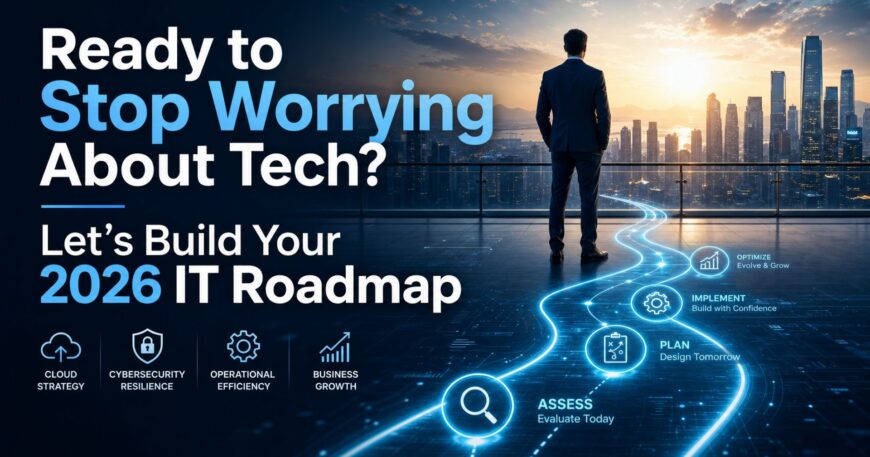
A real IT roadmap isn’t a wish list. It’s a documented, prioritized plan that connects your technology decisions to specific business outcomes, built around pillars like these:

Pillar 1: Lock Down Your Cybersecurity Before It’s Too Late
Cybersecurity is non-negotiable. Today, 43% of all cyberattacks target small businesses, yet many SMBs acknowledge that their defenses are not mature enough to protect them. Your IT roadmap must include layered protection: firewalls, endpoint security, employee training, and real-time threat monitoring. Waiting until after an attack is far costlier, financially and reputationally, than building prevention in from day one.
Pillar 2: Move to the Cloud (The Right Way)
Cloud adoption is one of the most powerful levers for business flexibility, but “moving to the cloud” without a strategy creates new problems. Your IT roadmap should define which workloads move, on what timeline, and to which platforms. Whether it’s Microsoft 365, cloud hosting, or a hybrid setup, intentional migration reduces risk and delivers real ROI.
Pillar 3: Backup & Disaster Recovery: Your Business’s Safety Net
How long can your business survive without access to its data — hours, minutes? A solid backup and disaster recovery plan is the difference between a minor disruption and a catastrophic loss. Your roadmap must define recovery time objectives, backup frequency, and who’s responsible for testing and restoring systems.
Pillar 4: A Network Built for Speed, Not Just Survival
Your network is the backbone of everything. Slow VPNs, dropped calls, and bandwidth bottlenecks quietly kill productivity. A 2026 network strategy includes proper segmentation, performance monitoring, and scalable infrastructure. Don’t just build for today’s workload, build for where your team will be 24 months from now.
Pillar 5: Unified Communications That Actually Unify Your Team
Email, video calls, instant messaging, VoIP — your team uses a dozen tools to stay connected. Without a unified approach, important information slips through the cracks. Your IT roadmap should consolidate communication platforms, reduce friction, and ensure remote and in-office teams are genuinely in sync, not just technically online.
Pillar 6: AI Integration: Stop Managing Tasks, Start Delegating Them
AI is no longer a futuristic concept; it’s a practical business tool available right now. From automating repetitive workflows and summarizing reports to flagging security anomalies in real time, AI frees your team for higher-value work. Your IT roadmap should identify which processes are AI-ready and which tools integrate cleanly with your existing infrastructure.
Pillar 7: IT Budgeting & Technology Refresh Planning
Technology has a shelf life. Running on hardware or software past its prime creates security gaps, compatibility issues, and hidden costs. Your roadmap should include a multi-year budget aligned to refresh cycles, so you are never blindsided by an aging server or end-of-life software again. Predictable IT spending is just smart business.
5 Warning Signs You Need an IT Roadmap Right Now
If you’re still unsure, answer these honestly:
- Are your IT costs unpredictable month to month?
- Have you experienced a security incident or data loss in the past 12 months?
- Do your employees work around broken or slow tools?
- Is your current setup hard to scale as your team grows?
- Does no one in your organization clearly own the IT strategy?
If you answered yes to even two of these, it’s time to build a plan — not next quarter, now.
How Managed IT Services Turn Your Roadmap From Plan to Reality
An IT roadmap on paper means nothing without execution. Managed IT services bridge that gap — combining strategic planning with hands-on support, including monitoring, maintenance, security patching, and ongoing optimization. Instead of reacting to problems, your team stays focused on growth while your IT partner handles the infrastructure.
A great managed IT provider doesn’t just keep the lights on; they also act as a strategic partner, helping you plan ahead, reduce risk, and make smarter technology investments over time.
That’s exactly what Sun IT Solutions does. Working with businesses across the GTA, our team helps you move from reactive firefighting to strategic IT management. We offer services including managed IT support, 24/7 system monitoring, cybersecurity protection, cloud management, data backup and disaster recovery, network optimization, and strategic IT consulting tailored to your business goals. We help build an IT roadmap that’s aligned to your goals, backed by proactive support, and designed to grow with you.
The Best Time to Build Your 2026 Roadmap Was Last Year. The Second Best Time Is Now
Every month without a plan is a month of unnecessary risk and wasted spend. Your competitors are building strategies while you’re still firefighting. A focused IT roadmap built around your goals, your team, and your growth plans is one of the highest-leverage investments you can make this year.
Ready to take the first step? Contact Sun IT Solutions today, and let’s build a roadmap that works for your business.

