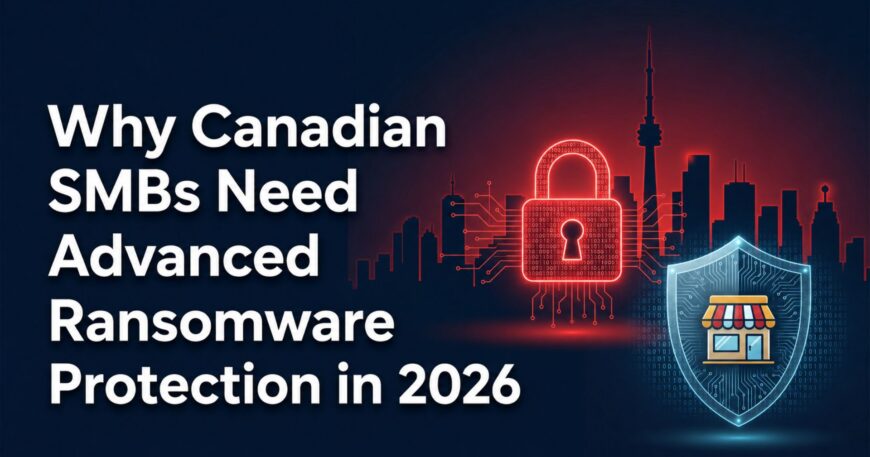
Canada’s small and medium-sized businesses (SMBs) are no longer “too small to target.” In 2026, ransomware groups actively prioritize SMBs because they are high-value, low-defence, and fast-pay environments. With rising digital dependency, cloud adoption, and remote work, attackers now exploit identity systems and misconfigurations more than traditional malware vulnerabilities.
Recent cybersecurity research shows that ransomware is not just increasing, but also evolving into a faster, more automated, and more financially damaging ecosystem. For Canadian SMBs, this shift makes advanced ransomware protection (beyond basic antivirus or backups) a business survival requirement.
The Rising Ransomware Threat Landscape in Canada
Recent threat intelligence reports show Canada consistently ranking among the top 3–5 most targeted countries for ransomware incidents globally, alongside the United States and Germany. Attack volumes continue to grow as ransomware-as-a-service (RaaS) lowers the barrier for cybercriminals.
Even more concerning is the growth rate. Ransomware incidents in Canada are increasing year over year, driven by automated attack kits and AI-assisted phishing campaigns.
SMBs are the Primary Target
Modern ransomware groups actively prefer SMBs because they typically lack:
- Dedicated security teams
- Advanced endpoint detection tools
- Continuous monitoring systems
According to recent industry data, SMBs represent the majority of ransomware victims globally, with attackers exploiting weaker identity controls and inconsistent patching practices.
Why 2026 Is a Turning Point for Ransomware Attacks
One of the most critical changes in 2026 is speed. Security intelligence shows that attackers can move from initial access to full network compromise in minutes or even seconds in some cases. This drastically reduces the effectiveness of manual response strategies.
Traditional “detect and respond later” models are no longer sufficient because modern ransomware groups often:
- Steal credentials silently for weeks
- Map internal systems before launching encryption
- Strike during off-hours to maximize disruption
Identity-Based Attacks Are Replacing Traditional Malware
A major shift in 2026 is that ransomware is increasingly delivered through:
- Stolen login credentials
- Phishing-as-a-service platforms
- MFA bypass techniques (token theft, session hijacking)
Security reports indicate that a significant share of cyber incidents now begin with identity compromise rather than software vulnerabilities. This means firewalls alone are no longer enough because attackers often “log in” rather than “break in”.

The Financial Impact on Canadian SMBs
Recent IBM-based cybersecurity analysis shows that the average cost of a data breach in Canada is approximately CA$6.98 million, with financial-sector incidents exceeding CA$9 million.
While SMB breaches may be smaller in absolute terms, the relative impact is devastating:
- Downtime often halts revenue completely
- Recovery can take days or weeks
- Reputation damage leads to customer loss
Ransomware Downtime is the Hidden Killer
Beyond ransom payments, SMBs suffer from:
- Lost sales during downtime
- Operational paralysis (accounting, payroll, logistics)
- Recovery and forensic costs
- Legal and compliance exposure
Even when ransom is not paid, recovery expenses alone can threaten business continuity.
Why Traditional Cybersecurity Tools Are No Longer Enough
Legacy ransomware protection tools are designed to detect known malware signatures. However, modern ransomware:
- Uses legitimate credentials
- Operates through cloud apps (Microsoft 365, Google Workspace)
- Avoids traditional file-based detection
This makes perimeter-based security insufficient. In addition, many SMBs believe backups alone are enough for ransomware protection. However, attackers now:
- Actively locate and delete backups before encryption
- Encrypt cloud-synced backup folders
- Use double extortion (encrypt + leak data)
So even if data is recoverable, exposure risks remain.
The New Requirements for Advanced Ransomware Protection
There are now some new requirements to enforce advanced ransomware protection:
Identity-First Security is Now Essential
Since most attacks begin with stolen credentials, SMBs must prioritize:
- Multi-factor authentication (MFA) with phishing-resistant methods
- Privileged access controls
- Continuous identity monitoring
Endpoint Detection and Response (EDR/XDR)
Modern protection requires systems that:
- Detect suspicious behavior in real time
- Automatically isolate infected devices
- Correlate activity across email, endpoints, and cloud systems
Zero Trust architecture
Zero Trust assumes no user or device is inherently safe. It enforces:
- Continuous verification
- Least-privilege access
- Micro-segmentation of systems
This reduces lateral movement during an attack.
Human Risk Remains the Weakest Link
Despite advanced ransomware protection tools, human error continues to dominate breaches. A large majority of cyber incidents involve human interaction, such as clicking on malicious links or approving fake login requests.
Attackers increasingly use:
- AI-generated phishing emails
- Fake login portals
- Social engineering via SMS and messaging apps
Plus, SMBs without regular cybersecurity training are significantly more likely to suffer credential theft or ransomware infection. Training remains one of the highest ROI security investments.
What Canadian SMBs Must Do in 2026
Some of the best practices for advanced ransomware protection in 2026 include:
Move from Reactive to Proactive Security
SMBs must stop treating cybersecurity as an IT expense and start treating it as a business continuity system.
Key priorities include:
- Real-time monitoring instead of periodic checks
- Automated response systems
- Regular penetration testing
- Incident response planning
Build Resilience
Even the best systems can be breached. The goal is:
- Fast detection
- Rapid containment
- Minimal operational downtime
Resilience is what determines whether a ransomware attack becomes a disruption or a business-ending event.
Conclusion — Ransomware Is Now a Business Risk, Not an IT Issue
In 2026, ransomware is no longer a niche cybersecurity threat. It is a mainstream business risk affecting revenue, reputation, and survival. Canadian SMBs are especially vulnerable because attackers actively target them for their weaker defenses and higher likelihood of paying or suffering disruption.
With multi-million-dollar breach costs, rapidly evolving identity-based attacks, and increasingly automated ransomware ecosystems, advanced ransomware protection is no longer optional. It is now a fundamental requirement for staying operational in Canada’s digital economy.
If you are an SMB looking to protect your business from ransomware, we can help you put the right security controls in place before threats can disrupt your operations. At Sun IT Solutions, our services include managed IT support, endpoint protection, backup and disaster recovery, email security, network monitoring, and proactive threat detection designed specifically for growing businesses.
We work as your IT partner to strengthen your infrastructure, reduce vulnerabilities, and keep your systems running securely and consistently. Get in touch and let’s get started!

